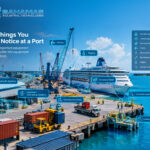

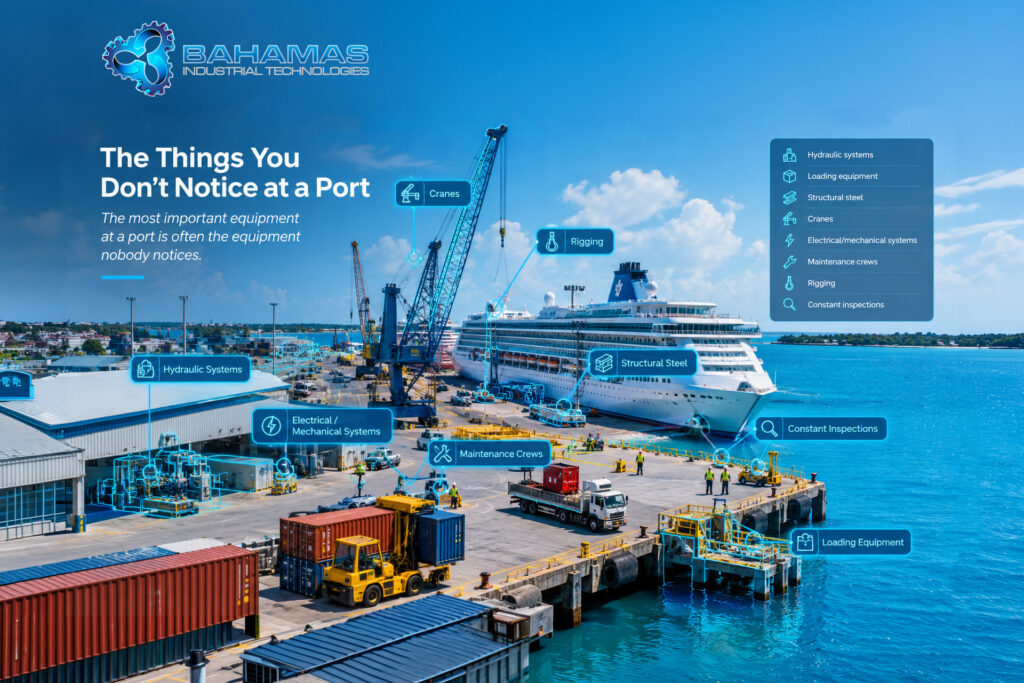
The Things You Don't Notice at a Port
The most important equipment at a port is often the equipment nobody notices.
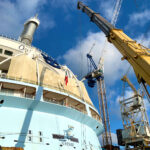
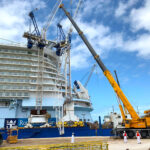
When most people look at a port, they see a ship, the water, cranes on the horizon and perhaps cargo being loaded or unloaded.
They see the destination. The arrival. The departure.
What they don't necessarily see is the complex network of equipment, mechanical systems and skilled professionals working behind the scenes to keep everything moving.
Because a functioning port is about much more than the ships that pass through it.
It's about everything that makes their arrival, servicing and departure possible.
Beyond the Ship and the Water
Ports are busy industrial environments where numerous systems must work together.
Cranes and lifting equipment handle heavy loads. Hydraulic systems power machinery and control movement. Structural steel supports critical infrastructure. Mechanical and electrical systems keep equipment operating.
Then there are the components people rarely think about: hoses, fittings, cylinders, connections, lifting accessories and the countless parts that must perform reliably under demanding conditions.
Individually, these components may seem insignificant.
Together, they help keep port operations running.
And when one critical component fails, the consequences can extend well beyond the equipment itself.
The Systems You Don't See
Much of a port's essential infrastructure operates quietly in the background.
Hydraulic systems provide the force and controlled movement required by many types of industrial machinery. Hoses, seals, cylinders and fittings must be maintained to help prevent leaks, failures and unnecessary downtime.
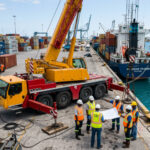
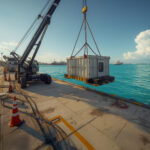
Cranes and rigging equipment make it possible to lift, position and move heavy loads. These operations depend on appropriate equipment selection, careful planning, inspections and qualified personnel.
Structural steel and fabrication provide the framework for platforms, supports, industrial structures and other infrastructure that must withstand demanding operating conditions.
Mechanical and electrical systems help equipment function as intended. Identifying wear, faults or developing problems before they become major failures is an important part of maintaining reliable operations.
None of these systems may be the reason someone visits a port. But they are part of what allows the port to do its job.
The People Behind the Equipment
Equipment is only part of the picture.
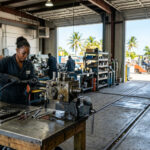
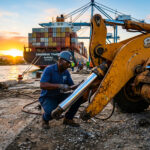
Behind the machinery are technicians, mechanics, welders, machinists, crane operators, riggers and maintenance crews whose work often goes unnoticed by the people passing through.
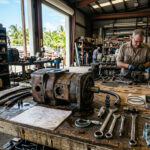
Their responsibilities can include inspecting components, troubleshooting faults, restoring hydraulic cylinders, repairing machinery, fabricating steel parts and preparing equipment for its next job.
Much of this work isn't particularly visible.
A successful repair might mean that a machine never misses a shift. A thorough inspection might prevent a small problem from becoming a major one. A properly restored component might help avoid the cost and delay of sourcing a replacement.
When everything works as it should, people may never know the work was necessary.
That's often the point.
Why Maintenance Matters in The Bahamas
Operating industrial equipment in a marine environment brings its own challenges.
Salt-laden air, humidity, moisture and demanding working conditions can accelerate corrosion and contribute to wear on exposed equipment and components.
For operations in The Bahamas, logistics can add another consideration. When a critical component needs replacement, sourcing it from overseas may introduce shipping delays, additional costs and uncertainty.
That makes inspection, preventative maintenance and timely repairs particularly important.
Recognizing a problem early can provide more options. Depending on the component and its condition, repair, restoration or fabrication may be worth considering alongside replacement.
The right solution always depends on the equipment, the extent of the damage, safety requirements and the manufacturer's or engineer's specifications. But having the technical capability to assess the problem can make a meaningful difference.
Keeping the Port Moving
At Bahamas Industrial Technologies, we understand that industrial operations depend on more than the most visible pieces of equipment.
Our work includes mobile crane rentals, rigging and transportation solutions, hydraulic hose assemblies and fittings, hydraulic cylinder restoration, machine shop services, welding, structural steel fabrication and surface preparation.
These capabilities support the wider industrial environment in which ports, shipyards, construction projects and other facilities operate.
Whether the requirement involves a heavy lift, a hydraulic repair, a machined component or a fabrication job, the objective is to provide practical industrial solutions that help customers keep their operations moving.
Because the work that happens behind the scenes matters just as much as the activity everyone can see.
The Most Important Work May Be the Work Nobody Notices
The next time you look at a ship alongside a dock, take a moment to look beyond the vessel.
Look at the cranes. The lifting equipment. The steel structures. The machinery. The people carrying out inspections and maintenance.
Consider the systems that must work together, often for hours at a time, to support the movement of goods, equipment and people.
A port is not simply a place where ships arrive and depart. It is a complex industrial environment that depends on equipment, expertise and ongoing maintenance.
And much of the work that keeps it operating happens out of sight.
The most important equipment at a port is often the equipment nobody notices.
At Bahamas Industrial Technologies, we know that keeping industry moving starts with taking care of the things most people never see.